
Sharing the Mic: How Beatles Harmony Was Born—and Became Magic

On February 9th, 1964, seventy-three million Americans watched The Beatles perform on The Ed Sullivan Show and collectively lost their minds. Why? They thought it was the haircuts. They thought it was the accents. Maybe it was four impossibly charming young men in matching suits doing something dangerous to their daughters. They were wrong about all of it. What they were actually watching—without knowing it—was one of the great techniques in music: two men pressing their faces together into a single microphone and producing harmonies so unnaturally tight they sound engineered by someone with a physics degree. John and Paul, sometimes George and Paul, sometimes all three, cheeks touching, eyes half-closed, breathing the same air. George tucked in on the third part. One mic. One sound. No idea what they were doing or why it worked so well. 🎙️
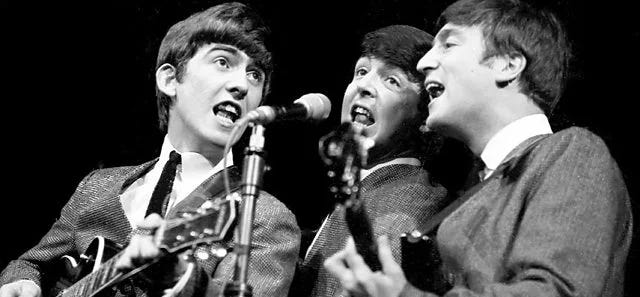
“This Boy” is the perfect example. Three-part harmony, one mic, delivered live. Today we’d call that pressure. In 1964 they called it Tuesday.
But here’s the question worth asking: was this beautiful intimacy a compromise dictated by primitive 1960s technology, or was it a deliberate artistic choice that shaped the entire look and sound of the Fab Four? The answer, like most things Beatles-related, is more interesting than either option alone. 🔍
The Hard Truth: Abbey Road Ran Out of Room
Let’s start with the cold technical reality, because it’s genuinely hilarious how limited the tools were compared to what the band produced.
When The Beatles walked into EMI’s Abbey Road Studios in 1963, producer George Martin was working on two-track recording machines. Two tracks. Total. For the entire song. Instruments on one, vocals on the other—maybe. By 1963 they’d upgraded to four-track, which felt like going from a unicycle to a sports car. The problem: every track had to earn its place. You couldn’t just drop a vocal harmony on its own isolated channel and sort it out in the mix later. You pointed multiple human beings at a single microphone, blended their voices in physical space, and committed. If someone was slightly flat, congratulations, it was now on the record forever.
This is why, when John and Paul shared a mic, it wasn’t romance. It was engineering pragmatism. You’ve got four tracks, a bassist, a drummer, a lead guitar, a rhythm guitar, and three vocalists—something had to give. 🎚️
The live situation was even more chaotic. Concert PA systems in 1964 used the equipment designed for football stadiums and airport terminals, not music. A typical venue might offer two or three microphone inputs for the entire stage. The Beatles were sharing mics on stage not necessarily because they wanted to, but because there weren’t enough to go around.
There were no stage monitors. None. The earphones and wedge speakers that allow modern performers to hear themselves? Didn’t exist yet. The Beatles were performing in arenas and stadiums with girls screaming at volumes that would drown out a jet engine, and they couldn’t hear a single note they were playing. Standing physically close to each other—close enough to hear the acoustic sound of each other’s actual voices—was the only way to stay in tune. It was either that or play the whole show on autopilot and hope for the best. Which, frankly, sometimes happened anyway.
But Then Something Interesting Occurred
Here’s where the story gets genuinely fascinating, and this is the part that separates a technical limitation from an artistic discovery.
Multi-track recording improved rapidly through the late 1960s. By the time they were recording Sgt. Pepper’s in 1967, they had access to four-track machines that they were bouncing together to create effectively eight tracks. By Abbey Road in 1969, proper eight-track recording was available. The technical necessity of sharing microphones had essentially disappeared. 😮
They kept doing it anyway.
When John and Paul or John and George pressed close to share a capsule, something happened acoustically that you cannot replicate by recording voices separately and blending them in post-production. Multiple voices hitting a single microphone create what engineers call natural compression—the louder voice pushes slightly against the quieter one, the breath of one singer slightly influences the airflow around the other, and the two sounds blend in physical space rather than being artificially combined in a mixing console. The result is a texture that sounds like one organism rather than two separate creatures stitched together.
Listen to “Baby’s in Black” next time you get the chance. Listen close enough and you can actually hear them smiling at each other on certain syllables, reacting to each other in real time, because they’re standing three inches apart reading each other’s faces. That’s not something you get from sending two singers into a vocal booth on different days and stacking the tracks. Chemistry required proximity. 🎧
They Learned It From the Best
The Beatles didn’t invent this, of course. They inherited it from a long tradition they’d absorbed obsessively as teenagers.
The Everly Brothers—Don and Phil—are the most direct antecedent, and John and Paul said so explicitly. The Everlys built their entire sound around sharing a single microphone to achieve a “one voice” blend that became the template. Their harmonies on records like “All I Have to Do Is Dream” and “Cathy’s Clown” sound like a single singer somehow singing two notes simultaneously, and the technical secret was that they were physically inseparable at the mic. John Lennon worshipped the Everly Brothers as a teenager. You can hear it in literally every harmony the Beatles ever recorded. 🎸
Before that, the Ink Spots and The Platters and the entire doo-wop tradition had established the visual and sonic grammar of multiple voices around one microphone out of pure technical necessity. Barbershop quartets had been doing it for a century. Bluegrass and folk performers routinely gathered around a single large-diaphragm microphone and self-mixed their entire performance by physically stepping forward to get louder, then stepping back to get softer—no faders, no engineer, just body movement.
The Beatles grew up on all of it. They were sponges. By the time they were recording “This Boy” in November 1963, they were executing a tradition that stretched back decades, but doing it with a sophistication and naturalness that made it feel completely new.
The Disciples
Once the Beatles made it iconic, everyone wanted a piece.
The Beach Boys were building their cathedral harmonies around shared microphone setups throughout the mid-1960s, stacking Brian Wilson’s arrangements with the kind of voice-blending that requires physical proximity to achieve. The Bee Gees, another band of brothers with an almost supernatural harmonic instinct, used the same approach in their early career to lock in the blend that became their signature. ✌️
Later it became about attitude as much as sound. When Joe Strummer and Mick Jones of The Clash shared a microphone on stage, they weren’t doing it because they couldn’t afford a second mic stand. They were doing it because two guys pressed together screaming about white riots and career opportunities was a visual statement about solidarity and defiance that a second mic stand would have completely destroyed. Same with Liam and Noel Gallagher of Oasis—their occasional shared-mic moments carried the weight of brotherhood, rivalry, and mutual dependence all at once. The image communicated things the music alone couldn’t.
Today, indie and folk artists regularly choose to record around a single microphone as a deliberate rejection of sterile digital perfection. In an era when you can auto-tune isolated vocal tracks with mathematical precision and spatially place each voice anywhere in a three-dimensional soundscape, pointing two people at one microphone and pressing “record” is almost an act of defiance. It says: we want the breath, the imperfection, the human proximity. We want to sound like people, not software.
What It All Adds Up To
The shared microphone started as a practical response to primitive technology. Two-track machines, three available inputs, screaming teenagers obliterating any possibility of hearing yourself play—these were problems to be solved, not aesthetic statements to be made.
But somewhere between Liverpool and The Ed Sullivan Show, the constraint became the style. The limitation became the point. 🎶
John and Paul—and George and Paul—pressing their faces together didn’t just produce better harmonies—it produced a musical telepathy that you can actually hear in the recordings. It forced eye contact, synchronized breath, shared phrasing, and a physical attentiveness to each other that no amount of studio technology has ever been able to manufacture after the fact. It made them listen to each other in a way that changed all of them as musicians.
The shared microphone is the single best metaphor for what the Beatles were at their peak: four individuals so close together, so attuned to each other, so dependent on each other’s presence, that they produced something none of them could have made alone. The microphone didn’t just pick up their voices. It required them to become one.
Get the book:
